

Riparian Zone Restoration By Removing Reed Canary Grass
A project to remove invasive reed canary grass (Phalaris arundinacea) in partnership with World Wildlife Foundation
For many years, sections of the Tatalu (Little Campbell River) have been inundated by the invasive reed canary grass (Phalaris arundinaceae), which was originally introduced to the Lower Mainland as cattle feed and has since quickly spread throughout the region. Reed canary grass alters natural waterways, increasing the river temperature and causing flooding, which in turns leads to increased spread of the invasive species. Our Conservation Science team is working alongside local landowners throughout the Tatalu Watershed to restore the riparian buffer adjacent to the river.
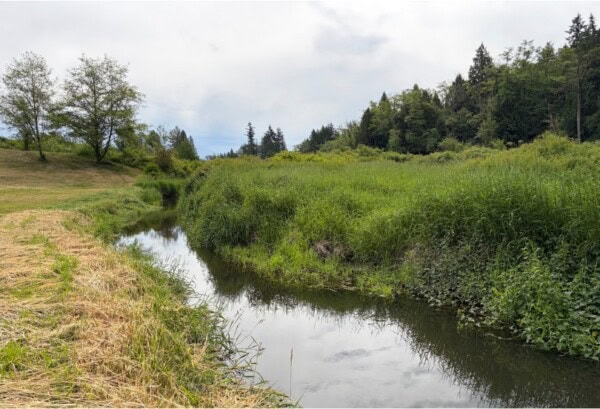
Reed canary grass along the border of the Tatalu before we began restoration efforts
This restoration project, funded by WWF, is co-led by Laura Tsai, Restoration Biologist with A Rocha Canada and Jacklyn Barrs, Ecosystem Restoration Specialist with WWF. The aim is to remove reed canary grass from the farmland properties that border the Tatalu, in order to restore the native biodiversity which is integral to the health of the river ecosystem.
“We are working with farmland owners to manage invasive vegetation along their properties adjacent to the river, and restore the riparian buffer that’s so critical to the river and our local wildlife. When we have neighbours and landowners that are excited and hopeful, it’s encouraging and it makes the hard work worthwhile.”
– Laura Tsai, Restoration Biologist, A Rocha Canada

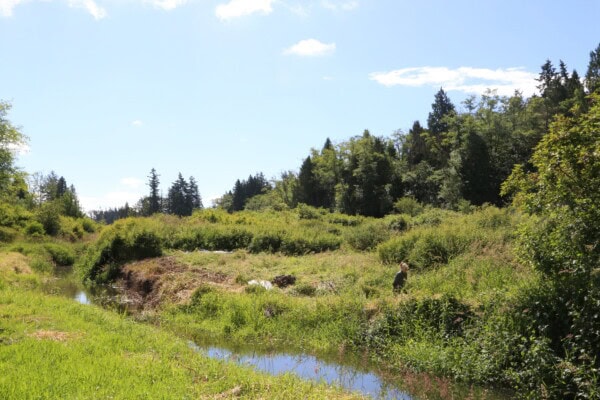
Border of the Tatalu after we cleared reed canary grass.
The presence of reed canary grass in the riparian zone of the Tatalu creates a monoculture that outcompetes the native plants that benefit the riparian buffer, reducing habitat for native wildlife species, contributing to erosion of the riverbank, and even forming mats on the river surface that affect the water quality. In order to reverse the damage to the ecosystem, the reed canary grass must be completely removed.
Steps to Remove Reed Canary Grass
- Cut & tamp down the invasive plants to create a flat surface
- Use solarization techniques by laying benthic barrier (black tarp) over the area to prevent photosynthesis from occurring in the reed canary grass and to use the radiant heat to kill the roots and seeds in the soil
- Secure barrier with metal bars to prevent plant material from spreading under the barrier
- Leave for one full year before removing the benthic barrier
- Plant a dense covering of native wetland species in place of reed canary grass
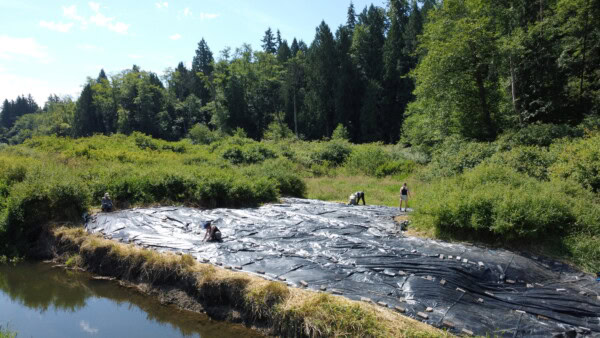
The team laying down the benthic barrier made of black tarp to prevent reed canary grass growth.
The radiant heat from the barrier will kill roots and seeds in the soil.
Reed canary grass, like many invasive species in the area, is shade intolerant. Benthic barriers are common practice for managing reed canary grass, as they starve the reed canary grass of light, limiting its growth. The methods for this project came from Tarasoff et al.’s (2022) study where, in addition to using benthic barriers, metal bars were added to prevent the roots from growing beyond the covered area. The ultimate goal of the project is to replace the existing canary grass with a dense canopy of native plants that will create shade, preventing weeds from endangering the biodiversity of naturally-occurring plants in the area and creating a healthy riparian zone.
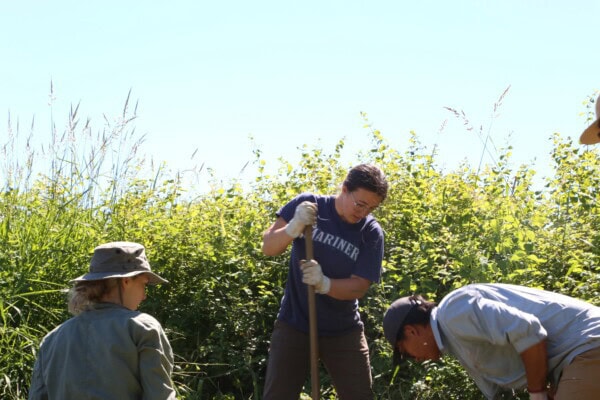
How you can get involved
This is the second year that A Rocha Canada has partnered with WWF doing riparian restoration on farmland, and we are grateful for an ongoing grant from WWF to continue this work. If you’re keen to explore the conservation potential of your land in South Surrey, BC, contact our team for a property visit to discuss possibilities for restoration and enhancing habitats for species at risk.