

The California Spreadwing: a New Damselfly for Metro Vancouver
The California Spreadwing (Archilestes californicus) was spotted in Metro Vancouver for the first time at A Rocha Canada’s BC Centre in south Surrey. Read more about how the species is expanding its range and how you can get involved.
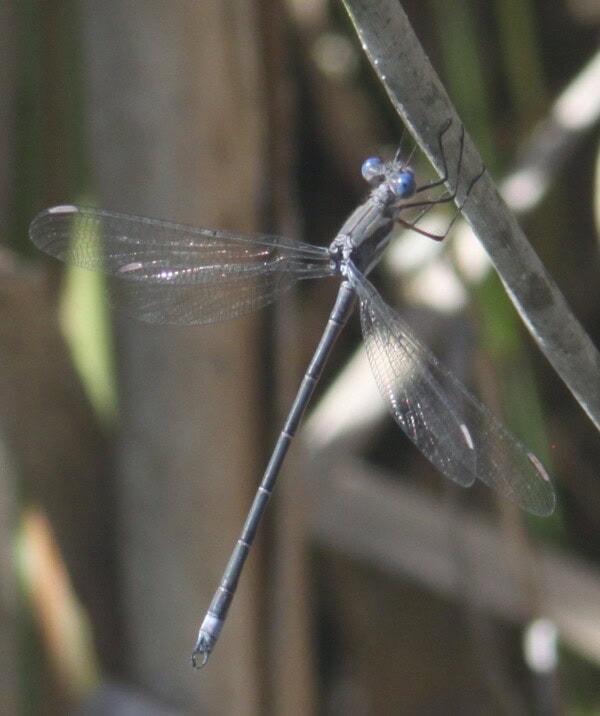
The Californian Spreadwing (Archilestes californicus) was spotted for the first time in September 2025 in Metro Vancouver.
In September 2025, the A Rocha team came across an unusual insect visiting the wetland at our BC Centre (read our blog here for more of the story). The California Spreadwing is a large damselfly- up to 6 cm long- which was previously known in Canada only from the Okanagan Valley, more than 200 km to the east.
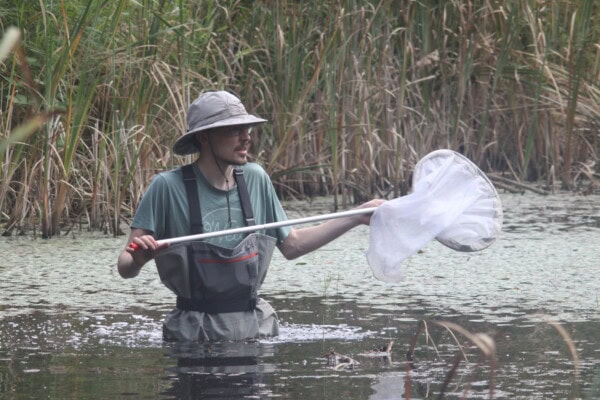
Sweepnets are typically used to survey Odonate species, shown here by Steven in a pond at the BC Environmental Centre.
The visitor didn’t stick around for long, but there is reason to think that more of them will be found in the future: data from citizen science platforms like iNaturalist, BugGuide, and Odonata Central shows how the California Spreadwing has expanded its range up through western Washington State over the last twenty years.
We worked alongside dragonfly experts to write an article about the find and the species’ history in the Pacific Northwest. You can read the article (now in press at the Journal of the Entomological Society of BC) here.
What is a damselfly?
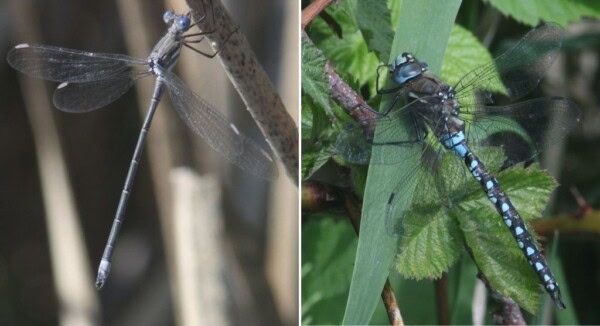
The California Spreadwing damselfly (left) and the California Darner dragonfly (right).
Damselflies are close relatives of dragonflies, and can be found in many of the same places. All damselflies have four skinny, membranous wings and a long thin abdomen. Many have bright colouration and bold patterns of stripes or spots. The larvae live in water and eat small aquatic invertebrates, while the flying adults glean prey such as aphids off of pondside vegetation. In both stages of life they fill an important role in pond ecosystems. Compared to a dragonfly, a damselfly tends to be a slower flyer with a thinner body and a wider, dumbbell-shaped head. Most damselflies are smaller than dragonflies, although a few (the helicopter damsels of Central and South America, which can reach a wingspan of 19 cm) are larger than any living dragonfly.
Why this record matters
If the trend continues, the California Spreadwing could someday be a familiar sight around the Lower Mainland of BC. It will be important to understand the ecological niche it fills in wetlands in BC, and how it is spreading during this early stage. Citizen scientists could play the primary role in this documentation.
How you can get involved
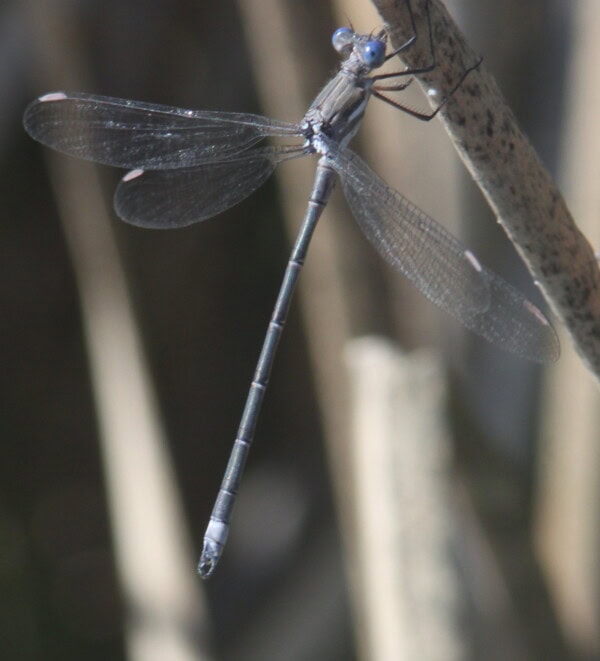
- Keep a lookout! Further sightings of the California Spreadwing might be expected this year in ponds in southern Surrey, Langley, or Abbotsford during the months of July through October.
- At a distance, look for a large damselfly (it is the largest species in BC by a significant margin) perched on cattail or sedges with its wings held open at a roughly 45 degree angle. Dorsally its colouration is broadly similar to some of our other spreadwings (Lestes sp.), with which it is the most likely to be confused. Notice however the pterostigmas (the rectangular opaque spots near the tip of every wing) which are light-coloured in California Spreadwing, but (usually) dark in BC’s other spreadwings. Try as well to take a picture from the side- the best character for this species is the sides of the thorax, which have a distinctive striped pattern.
- Pond dippers may also have a chance to see the nymph, which would be a first for BC. Look for a large damselfly nymph (>3 cm, including the tail) with two dark bands on each gill. However, microscopy might be needed to confirm the species of a nymph.
- Find out more about becoming a citizen scientist. Use platforms like iNaturalist or eBird to record your observations.
- Join a biodiversity walk to learn about biodiversity that exists within your watershed.
Please feel free to email Steven if you have any questions, or information to add.