Connections
What do sheep, earthworms, and a novice farmer have in common?
By Tim Friesen, Livestock Manager at A Rocha BC Centre
Oct 28, 2016
“I didn’t know anything about fish. I’m an expert in relationships.”
Miguel Medialdea, Veta La Palma Fish Farm
When I first started working with the livestock at A Rocha, I went in with a blank slate. I didn’t know anything about the chickens and sheep and ducks and goats and turkeys (oh my!) that would fall under my care. I was trained in horticulture. I understood plants and soils. I studied cellular respiration and organic chemistry and plant pathology. I had no idea what to do when a chicken gets mites or how to train sheep to respect an electric fence.
That lack of knowledge was evident the very first week I started, in the early spring; lambing season. The only other person who knew what to do with a newborn lamb was away, and when I went out give the sheep a bit of hay, I almost didn’t notice there was a wet-looking, black creature standing underneath one of the ewes.
I did a double-take. Yup. That’s a lamb. There it is. Right there. Now what? I ran back to my computer, rapidly googling questions. Do I need to wipe the lamb down? Do I move them away from the other sheep? I hovered over the newborn like an anxious parent, running back to the computer to research any new changes. The lamb bleated, is that good? Bad? It laid down. Now it’s standing, is that normal? I was starting to feel like a hypochondriac.
I worried for no good reason. Momma knew exactly what she was doing all along, and was taking perfect care her new lamb. I didn’t need to interfere at all.
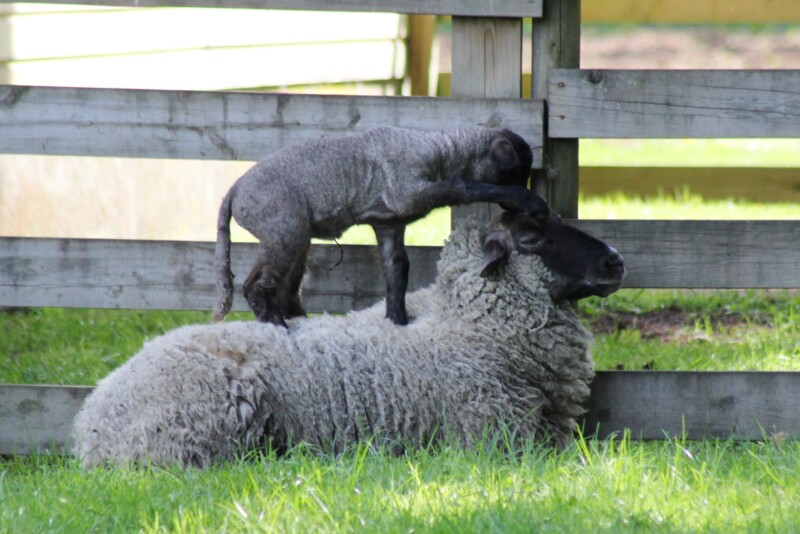
“Hey, ma? Ma? Maaaaa?” (Photo: Emily Upcott)
That’s when I learned what my job was really about: Relationships.
My job was mostly not about how to care for a lamb, or what a chicken needs to eat. They can do this themselves and are much better at it than me. My job was to cultivate relationships, to choreograph connections between plant and animal, soil and chicken, momma sheep and newborn.
The abundance of connections is staggering. Every time a sheep bites just the right amount off a tuft of grass, that plant responds by releasing a bunch of hormones, telling it to ramp up photosynthesis, which takes CO2 from the air and H2O from the ground and turns it into sugars. Some of these sugars are put together to make energy rich starches, fibrous cellulose, and all sorts of building blocks for the plants cellular structures. The grass grows back and that vegetation will get eaten again, fermenting in a four chambered, pickling machine that is a sheep digestive tract. Trillions of different microbes will feed off the amino acids, starches, and even the tough cellulose, and those microbes in return produce or make available most every vitamin and mineral the sheep will need. Much of which comes out the other end, in what seems to be a wasteful endeavor. But soon, yellow dung flies, carrion beetles, earthworms, and Onthophagus nuchicornis, a dung beetle that has incredible strength, colonize the fresh pats and work much of into soil, where it will rapidly break down, feeding the grass for more growth. Then brown headed cowbirds, robins and others come to feast on grubs, and even spend time chasing flies off the backs of the sheep. Those birds also bring in seeds in their own droppings, bringing new plants, that grow even more sugar secreting roots, not to mention pollen, nectar, and seeds for birds, bugs and bacteria, which further enhances these relationships. Which also grows more grass for sheep, of course. And on it goes.
But remember, that is only some of the sugars that the plant produces. The rest get secreted right out through the roots. Sugars, fats, and other nutrients just being deposited into the soil, feed arbuscular mycorrhizal fungi, Protozoa, Cyanobacteria, Rhizobium, actinomycetes, and eventually nematodes, earthworms, and the list goes on. These soil organisms extract, dissolve, transport and otherwise make available nutrients for the plants. Nutrients from the air, subsoil layers, animal manure, even taking nutrients from one plant that has abundance, to another plant that has too little. A highway system underground. They also release substances like glycoproteins and beta-glucans, and break down dead plants and excrement into humic acid, fulvic acid, and other compounds. Each of these performs roles, stimulating plant immune systems, creating ions that hold water and minerals in the soil, and even acting as a mild antifreeze to minimize frost damage to these soil organisms.
The idyllic simplicity of a lush pasture is a facade. It’s New York City. Times Square. On New year’s Eve. Multiplied by a zillion. All connected, and thriving.
This is what happens when the sheep eats the right amount of grass. Not too much. Not too little. And that’s where I come in. And all of us who choose to support sheep and duck and chicken and goat and pig farmers, as we strive to make sure our animals take the right amount of grass or seed or bugs according to the nature of the creature, and choreograph, with all the expertise we can muster, these increasingly complex connections between ourselves, our animals, and our land.
How can you participate in fostering connections?
There are vast and bustling connections designed into all creation, and we benefit greatly from being part of it! We have the responsibility and the ability to steward these connections. Here are some ways you can:
- Garden Greener – Create a thriving ecosystem in your own yard or garden box! We provide some resources to get you started.
- Caring for Creation at Church – Want to foster connections at your church community? This webinar series will equip those who want to stimulate creation care in their local congregation.
- Join our CSA – Looking to support a sustainable farm… and get a box of fresh, nutrient-rich produce every week? Our Community Shared Agriculture program is just the thing for you.