
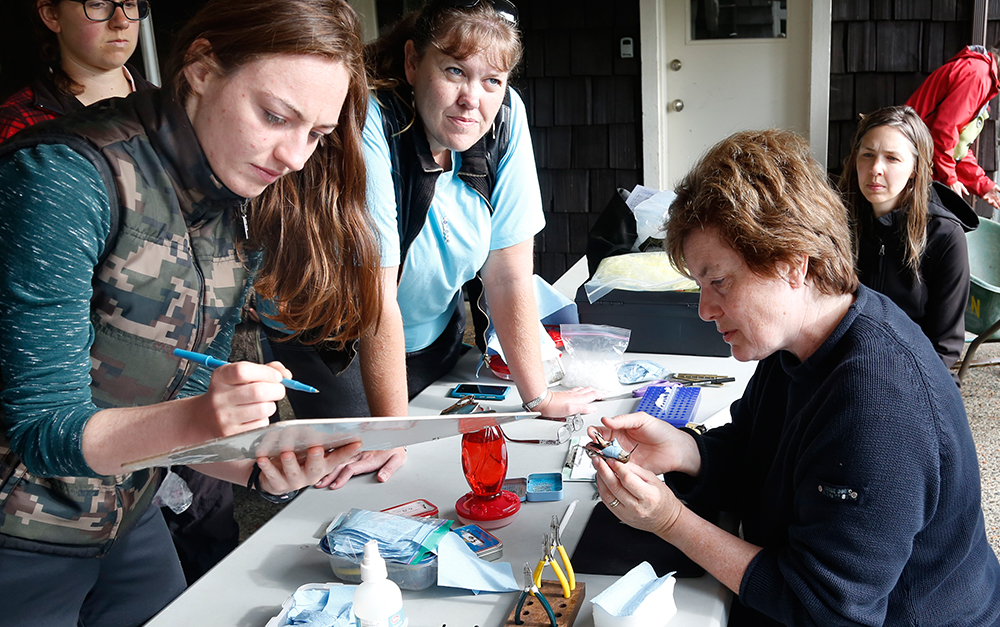
How do you band a bird that weighs just a few grams? Very carefully!
A Rocha’s Brooksdale Centre conservation team and volunteers were educated in the fine art of hummingbird research as they pitched in with research scientists Christine Bishop (from Environment and Climate Change Canada) and Alison Moran (of Rocky Point Bird Observatory) and their crew for two sessions of hummingbird monitoring, banding and sampling.
The group conducted two sampling sessions (April and May). Thanks to these dedicated scientists and volunteers, even in our first year we were able to capture Rufous and Anna’s Hummingbirds and collect cloacal fluid (aka ‘urine’) and some fecal pellets from the birds. These samples are now being analyzed for pesticides. Brooksdale is expected to be a reference site for another site nearby to a blueberry field where pesticides are sprayed. In particular, the scientists are interested in neonicotinoid insecticides although 15 other pesticides will also be measured. Results are expected in late November (so stay tuned!).
Besides the upcoming insecticide data, the study has already proved interesting. For example, a hummingbird was trapped at Brooksdale that was banded in a past year (by Derrick Matthews from Vancouver Avian Research Centre who banded here in the past). We also recaptured a Brooksdale-banded bird approximately 2 km away at another banding site, which is being monitored in Langley, beside a blueberry field. So, it seems these wee birds are travelling far and wide and managing to live year to year at their home base of Brooksdale!
Watch this space for the unfolding story.