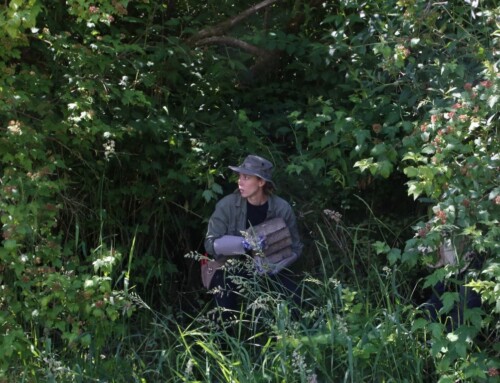
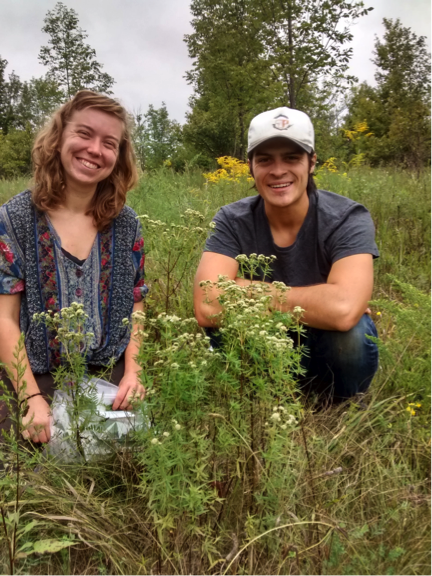
Initial biological surveys lead by a volunteer discovered a variety of Mountain Mint in the field and shrubland at Cedar Haven Farm that could potentially be the first record of the plant in the watershed. Armed with a general knowledge of the plant’s location, and field guides, the Cedar Haven team set out to identify and mark the plant’s location. Despite the plant’s showy flowers and fragrant foliage locating it proved more difficult than originally thought. During bird surveys, hikes, and plant finding missions, volunteers and staff grew familiar with the Yarrow, St. John’s Wort, Goldenrod, Queen Anne’s Lace, and other plants populating the meadow, but still could not locate the elusive mint plant. We were beginning to suspect that it had fallen prey to the nibbles of the hungry deer often spotted in the meadow. On the last work-day for our 2015 summer student, Ben, we were out in the meadow collecting leaves for plant and tree id cards. We decided to take one last attempt at locating the plant.
Rainclouds were gathering and we were about to give up once again when Ben found a plant with very minty smelling leaves. At long last we had found the Narrow-leaved Mountain Mint plant Pycnanthemum tenuifolium.
Pycnanthemum tenuifolium (narrow-leaved/slender mountain mint, Virginia Thyme) is provincially classified as “S3” or rare to uncommon with 21-80 known occurrences. Biologists from the local conservation authority suspect it is the only recorded observance of this plant in the Bronte Creek watershed.
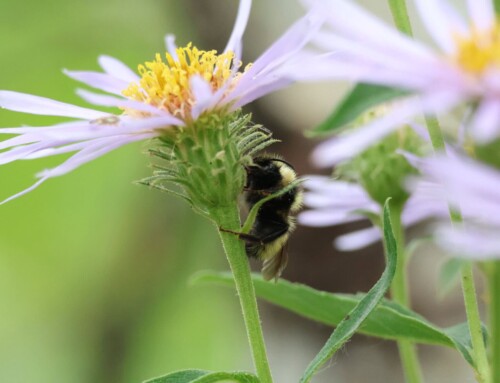
It has small tubular white flowers that grow in clusters and attract pollinators such as monarch (and other) butterflies, and bees. The slender pale green leaves have a strong mint fragrance and can be used to flavour teas. Pycnanthemum tenuifolium grows in a variety of soil, moisture, and light conditions but is often found in open, dry prairies and upland woods. In Southern Ontario this habitat is often turned into pastureland, agricultural fields, and urban developments.
A Rocha staff have now marked the plant so it will be easier to find in the future. Seeds were gathered in the fall to try and propagate more plants. Protecting and propagating the Narrow-leaved mountain mint will be an important part of a large ecological restoration project A Rocha staff are planning for Cedar Haven Farm.