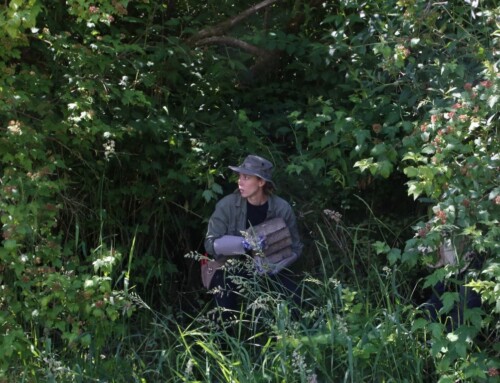
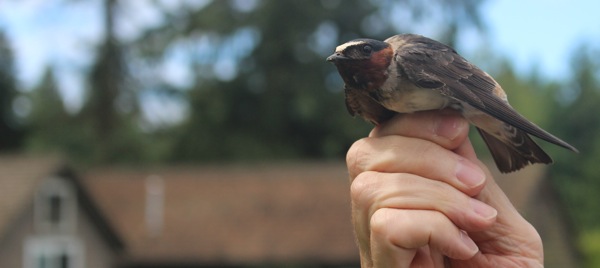
Brooksdale Environmental Centre’s heritage barn is home not only to A Rocha’s Community Shared Agriculture (CSA) operations, but also to a decades-old colony of cliff swallows. As organic veggies come in from harvest and go out to CSA shareholders on the ground level of the barn, cliff swallows swoop in and out of the eaves on the top level. In an effort to understand this species and these birds in particular, A Rocha has joined forces with The Vancouver Avian Research Centre (VARC) to capture, band and release these beautiful birds.
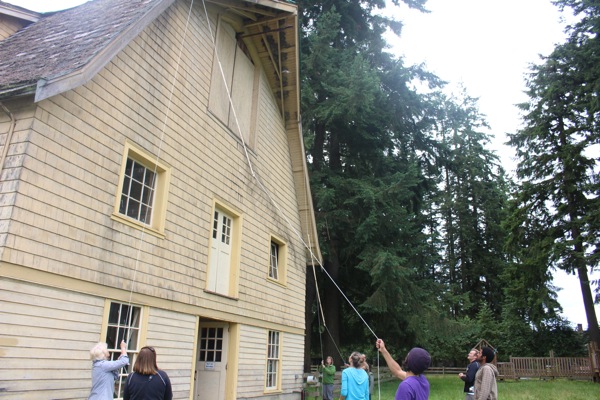
The first day of banding in late June (2014) was an exciting day for the Brooksdale team. The excitement requires some explanation as it was not just due to the fact it was the first banding to occur at Brooksdale; it was more to do with the ability to capture the birds. The planning took much longer than a typical ‘two poles and a mist net’ due to the awkward positioning of the cliff swallow colony. The colony of approximately 40 nests is situated on the gables of the aforementioned three-story hay barn. In order to get the net high enough to capture the swallows, a long ladder, two eyelets, a mist net on poles and a pulley system were required. Derek Matthews, from VARC, and the conservation science team rose to the challenge and came up with a successful system, allowing the team to catch, band and release over 20 birds.
Hannah Hereward, a Brooksdale conservation science intern from England, is currently monitoring some of the barn and cliff swallows within the Little Campbell Watershed. Monitoring of these two species is important due to their population declines – barn swallows by 80% and cliff swallows by 50% over the last 40 years. This decline has been shown to be, at least in part, due to a decline in insects. Insects are the swallow’s main food source. One of the aims of this project is to initiate an annual banding of the Brooksdale cliff swallows to gain further information about the species, including information on site fidelity and return rates. We hope that A Rocha’s data will help in the development of conservation strategies to help protect and preserve these iconic species.