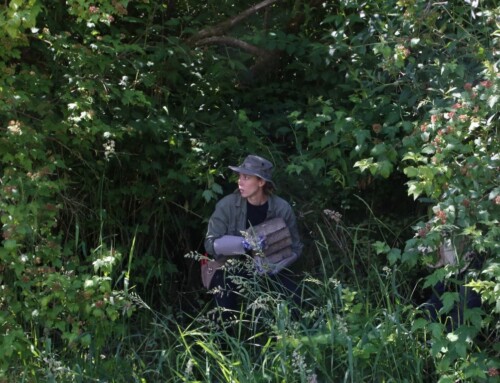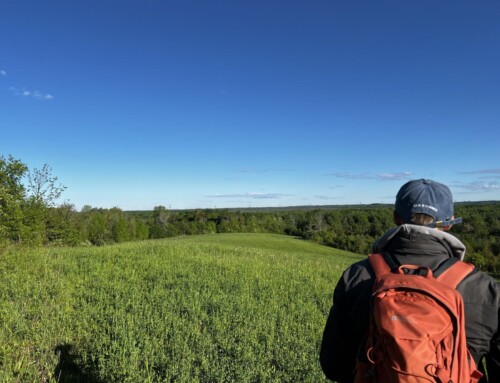
Part of my work with A Rocha is to support the conservation projects of other organizations. One such project is with the City of Toronto’s Community Stewardship Program. I co-lead a team of volunteers that help as ‘Community Stewards’ with habitat restoration at historic Milne Hollow in the city’s Charles Sauriol Conservation Area.
Below is a project update, originally shared on the Stewardship Toronto Facebook group. It will give you a glimpse into one way the A Rocha vision — the transformation of people and places by showing God’s love for all creation — is being realized in the Greater Toronto Area. I hope it will be an encouragement for you, as it was for the Milne Hollow Team.
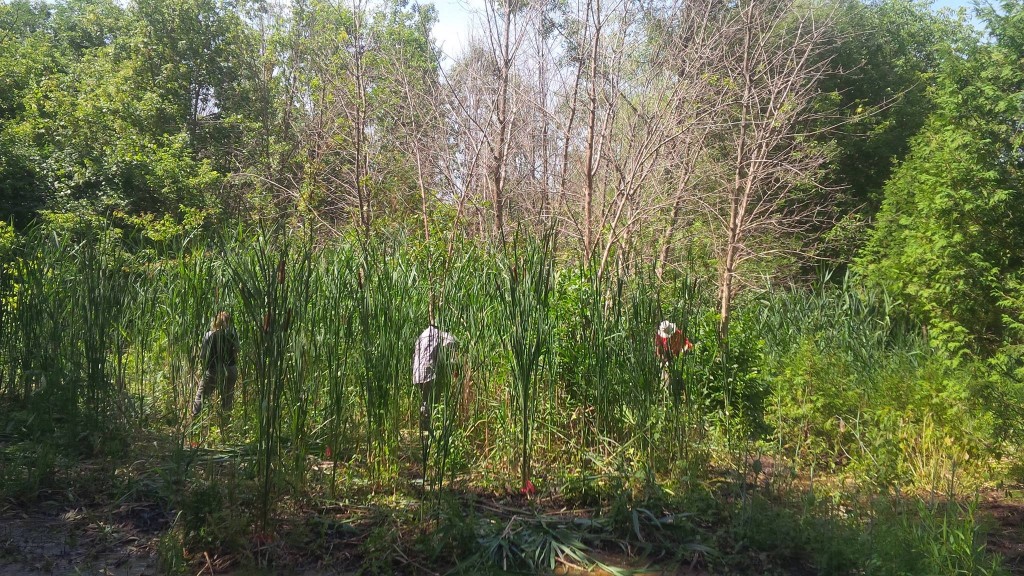
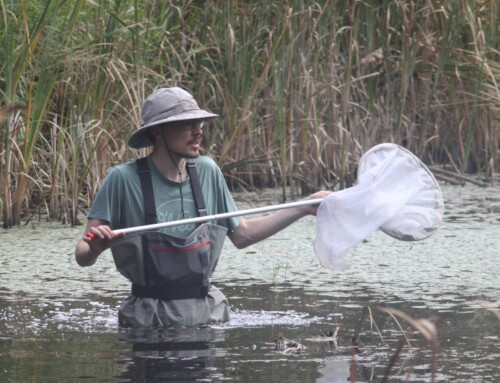
Volunteer Community Stewards manually controlling the spread of invasive common reed (Phragmites australis).
Look at all those cattails!* And amongst them, a few members of the Community Stewardship Program’s Milne Hollow Team cutting out invasive common reed (Phragmites australis). The other teammates and I, some of whom have been volunteering with the team longer than the five years that I have, have never seen so many cattails there. Further confirming our anecdotal observations, one of our teammates who had been caring for another location at Milne Hollow walked up and said, “Wow, look at all the cattails!”
In past years, we cut Phragmites’ stems in August to about a metre’s height. With other plants becoming increasingly part of the mix each year (or so it would appear), even if we’ve yet to get to the point where Phragmites is a marginal and easy-to-control invasive plant in that mix, biodiversity has been at least increasing. Slowly. But it’s increasing. Which is encouraging to everyone!
By applying what we learned in a workshop with Lynn Short in which she introduced us to her ‘spade technique’ (the plant is cut below the root crown and discarded) we are hoping that the cattails and other non-invasive plants, especially native ones, will begin to increase their presence exponentially. With an even greater reduction in the amount of Phragmites!
*I think they are mostly the native broadleaf cattail species (Typha latifolia), with the rest being narrow leaf cattails (T. angustifolia). I’ll confirm that later. Regardless, more cattails, whether broad or narrow leaf, is better than Phragmites! 🙂
If you live in or near Toronto and you’d like to volunteer with the City of Toronto’s Community Stewardship Program, either with the daytime team (Thursdays, 10 am until noon) or with one of the weekday evening teams, click here. And if you are interested in learning more about A Rocha’s support of it, click here.