Stan Olson, an A Rocha colleague in British Columbia, posted that it’s Invasive Species Awareness Week in that province. We don’t have such a week in Ontario. Maybe that’s because we have too many ‘alien invaders’ and we just need to be plain aware of them(?). I don’t know. Just be aware of them! Check out the website for Ontario’s Invading Species Awareness Program. To quickly appreciate the rationale, see the Invasive Species diagram. For the sake of your immediate health and safety (ultimately, they’re all a threat to our—and future generations’—long-term health and safety since they’re a threat to biodiversity), be familiar with identifying giant hogweed.
Confusing to the average person I speak with about invasive plants, although they are all weeds, not all weeds are invasive. They can even be rather beautiful (yes, that’s subjective). And occasionally sweet and delicious, too! Just not to native predators, or enough of them (that’s objective!).
Join me at: the Oak Ridges Moraine Land Trust’s StarCliff Nature Reserve; with the City of Toronto’s Community Stewardship Team at Milne Hollow, Charles Sauriol Conservation Area/Reserve; and/or on one of my near-daily walks or hikes in the ravines of Taylor-Massey Creek and I’ll introduce you to what A Rocha and our community partners are doing (in the case of the City of Toronto, what the lead environmental steward—the City of Toronto—Toronto and Region Conservation (the city’s lead professional partner) and its community partners—including A Rocha through our volunteer support of the Community Stewardship Program) to assist with caring for the green spaces that a number of plants are invading. Community Stewardship is Thursday mornings through the end of September from 10 am until noon. To arrange for a hike at StarCliff, call me or send me an email. I’m up there a lot but it varies with the season and how well we’re doing with controlling the growth—and ultimately the spread—of the invading plants. And/or tell me when and where you want to meet in Taylor Creek Park or Warden Woods. I’m flexible (depending on who you ask!).
The following photos with descriptions are for one of the locations—and one of the simpler ones to manage, and therefore photograph—at the StarCliff Nature Reserve where, under my leadership, A Rocha is managing the growth and potential spread of garlic mustard (Alliaria petiolata). Garlic mustard was first discovered at the Nature Reserve at the beginning of July 2010 (at a different location to the one shown below) and after it was too late to control it that year since it had already begun seeding. Formal control therefore began the following spring in April 2011.
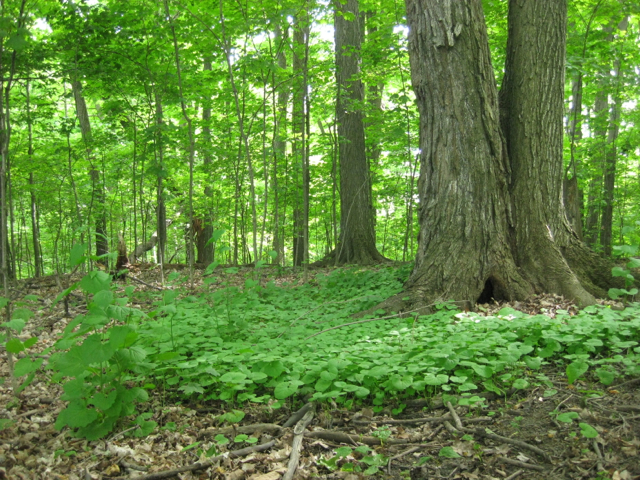
Spring 2012 – Discovered (at this location). Likely spread to location in 2010. Three second-year, soon-to-seed garlic mustard plants (biennial) were uprooted and discarded (in seed-destroying, anaerobic compost system (municipal)).

Spring 2013 – Before the soon-to-seed plants (it’s a biennial) were uprooted.
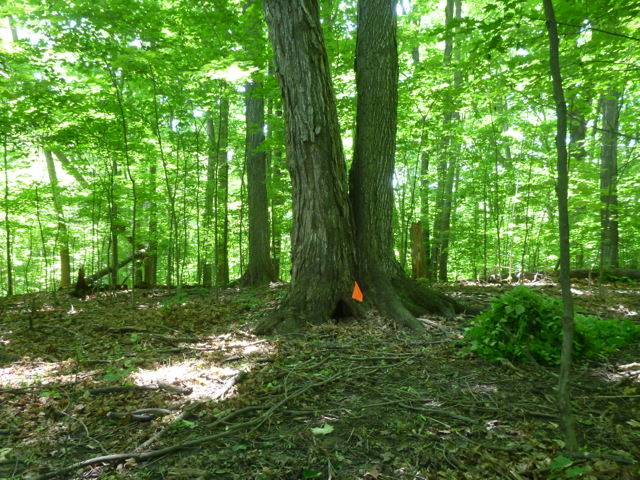
Spring 2013 – After the soon-to-seed plants were uprooted (and carefully removed from the nature reserve in contractor-grade garbage bags and discarded in the same manner as in the previous year).
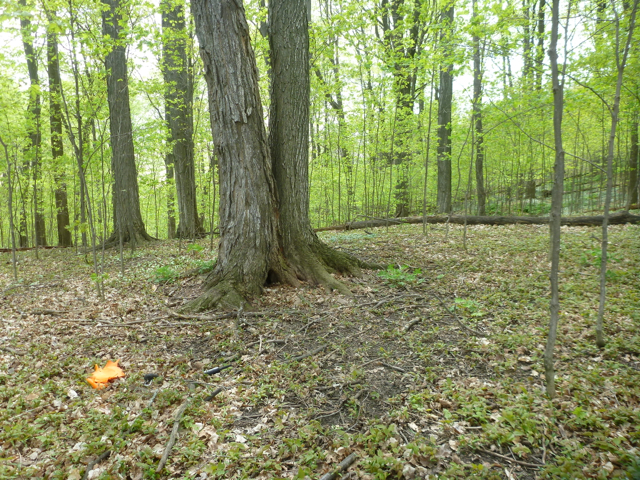
Spring 2014 – Monitoring-only, and removal of second-year garlic mustard is unnecessary. However, there are seedlings of first-year garlic mustard rosettes. Removal, therefore, will be necessary in the spring of 2015. Seed remains viable in soil for at least 5 years. Monitoring, therefore, must continue into spring 2016. Note the presence of sugar maple seedlings, which weren’t present in the previous two years. Nearby Virginia waterleaf, trout lilies, bloodroot and other native plants will also soon have the opportunity to potentially spread into the location.