Two are better than one, because they have a good reward for their toil.
The Teacher in Ecclesiastes (NRSV)
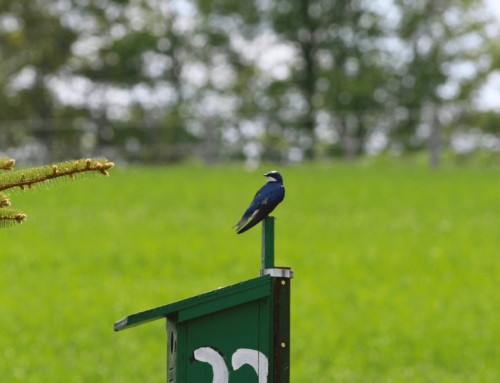
As many of you know, A Rocha Canada has been expanding in Southern Ontario. Yesterday, I had the honour of helping Hamilton A Rocha for the first time at the Friends of A Rocha Cedar Haven Farm in the Greenbelt* portion of the sprawling municipality, where students from Hamilton District Christian High School blessed the Farm with 30 or so students and teacher volunteers. When there, half of them helped Luke Wilson, A Rocha Canada’s Communications Director & Ontario Coordinator, install Four Seasons-quality songbird nesting boxes that were made by some of them and their peers in their high school’s shop class. And the other half helped Peter Scholtens, Hamilton A Rocha’s Community Organizer, and I begin the restoration of native woodland habitat by uprooting aggressively invasive common buckthorn (Rhamnus cathartica) and replanting with native trees and shrubs.
As A Rocha’s Stewardship Coordinator in the GTA and because of the work A Rocha and friends do with the Oak Ridges Moraine (ORM) Land Trust, especially at the environmental charity’s StarCliff Nature Reserve, and because of our work in support of the City of Toronto’s Natural Environment and Community Programs’ environmental stewardship projects (plus my earlier work with the Ontario Ministry of Natural Resources, Evergreen and their project partners) I am, unfortunately, all too familiar with common buckthorn. Under my direction and in consultation with the ORM Land Trust, for the last four years we’ve been strategically controlling its presence at StarCliff. Due to vigilant stewardship, there is less and less common buckthorn each year where it’s being controlled.
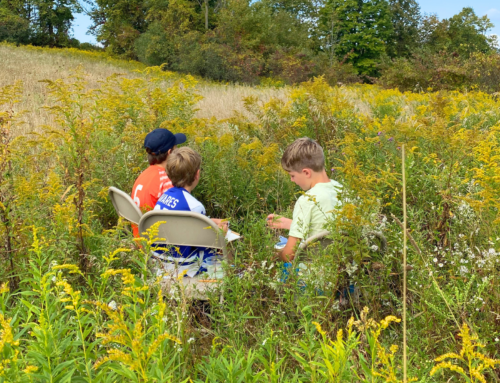
A variety of capacities have limited the extent of the restoration efforts–there are certainly a couple of locations we haven’t been able to work on–yet! With the Extractigator (the orange tool in the below photo that makes Fiskars’ tool for uprooting dandelions and other lawn weeds look like a pen knife), though, I think we can increase some of that capacity. We could use a commonly used herbicide, but not with community volunteers, and not without a licence. It might be part of the restoration arsenal in the future but if we can effectively control its growth without it, I’d like to. As would most conservationists.

Student volunteers uprooting common buckthorn (Rhamnus cathartica) with the Extractigator.
Our greatest efforts this past year–and the previous two–have been on controlling the spread of the even more invasive garlic mustard (Alliaria petiolata). Dog-strangling vine (Cynanchum rossicum) has shown itself at the property. Thank God–literally!–that it hasn’t been permitted to spread beyond the two locations where three vines have been found in the last four years. Two vines showed themselves again this summer after having been absent following the plant’s being removed upon its discovery in 2010. Aargh! But we won’t let it get past our monitoring it–with flags, GPS coordinates, and of course good ol’ regular, vigilant, on-the-ground observations, and, most importantly, uprooting it when found. Other plants controlled have included great burdock (Arctium lappa), black locust (Robinia pseudoacacia) and a few tree of heaven (Ailanthus altissima).
I like to think of the control of invasive plants as abstract tree planting. Most volunteers like planting a tree. It feels good to see a result. Especially if it involves life. Even if competition for sun, water and soil nutrients will challenge that tree’s potential to be a living part of the ecosystem in initial years to follow. There are certainly cases where tree planting is very helpful, if not essential, such as at Cedar Haven Farm where we uprooted common buckthorn and planted shrubs and trees in its place, since there wasn’t much else growing there to provide favourable seed for restoring a biologically diverse habitat. There are even trees that volunteers planted at StarCliff; a project I lead when I worked with Evergreen six years ago. (The trees are looking good! Some of them were even ready to have their tree guards (protection from rodents and deer) and plastic mulch mats (giving them competitive advantage for water, soil nutrients and sun) removed a few weeks ago.) It’s wonderfully encouraging to see such results. But by weeding selectively at StarCliff, and yesterday at Cedar Haven Farm since we tried to leave growing the few native shrubs and trees that were initially dwarfed by the common buckthorn, we permit existing plants to grow and release their seed, which, with ongoing stewardship–monitoring, restoration and maintenance–results in trees, shrubs and a host of other plants (not all native, but such is the relational process of stewardship. The results are slower, but they’re super encouraging!
*For maps of Ontario’s Greenbelt, click here.