
Cultivating Hopeful and Active Earthkeepers
A reflection on the centrality of rhythms and companionship
By Whitney Buckner, Tatalu Conservation Residency Coordinator
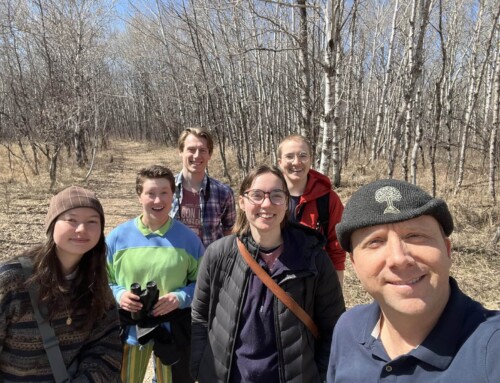
(In the above image, bottom row, on the far left)
March 26, 2026
My role at A Rocha is to coordinate the Tatalu Conservation Residency. This unique program is an immersive experience where young people, often in their late teens to early thirties, come to live at A Rocha’s southern BC centre for 3-9 months to apprentice in one of our program areas: conservation science, sustainable agriculture, or environmental education. In addition to hands-on conservation experience, residents receive robust theological teaching, participate in rhythms of community life and prayer, and form meaningful friendships.
In my role as organizer, pastor, and friend I’ve learned a thing or two about how to help cultivate characteristics of perseverance, hope, and committed action in young people. They need structure and rhythm as a road to life-giving habits and slow, steady, real transformation. They need to be folded into a community where their imagination for the good life can be nourished, expanded and reoriented. They need a place where their wonder is nurtured and their earnest care and concern for God’s groaning world is protected and encouraged. They need less paralyzing doom and more hands in the actual soil. Less consumption and entertainment, more creativity and production.
Structure and rhythm aren’t always built into the fluidity of modern life, but I have seen how meaningful daily and weekly rhythms can become. When the young folks I work with first arrive it can often feel like stretching some new muscles, but when they have experienced the residency rhythm – week after week showing up to truly good things like work outside, morning prayer, meals together, study, chore time, sabbath, etc. – freedom and flourishing begin to bloom. With these good things washed over them again and again their hearts are slowly shifted and oriented towards creation and towards the people around them. I’m convinced that structure and rhythm are some of the building blocks to becoming capable of hope, perseverance, and committed action. If these character traits are to form and mature, they simply need the fertile soil of daily practice to grow in.
The sweetness of enfolding the younger generation into a community made up of thoughtful people in many different seasons of life is immeasurable. They need friends who are younger than them, friends who are older than them, and friends who are way older than them. They need routines and activities that intertwine them with young families and retirees and folks from different cultural and economic backgrounds. And we need them. It’s a gift and privilege to be in close community with zealous young people, for they haven’t yet given up or succumbed to apathy. They also have a capacity for wonder that older adults have often lost. However, as their world gets bigger this may fade unless they have people in their lives, both old and young, cheering on and inspiring their care and concern, and delighting in creation with them. Delighting together in God’s resilient world will carry us through moments of great despair, frustration and disbelief. If young people don’t have adults who are doing that with them then it’s going to be much harder for them to do it on their own.
Additionally, a diverse community will have the ability to share knowledge about art, life skills, how to repair things, mending, cooking, and hopefully the art of paying attention. All things many young people are missing in substantial ways. We, the non-“young people,” have a responsibility to seek organizational and personal structure that bucks the trend of being siloed into groups that all look and talk like us. Instead, we need to be looking for ways to engage the whole village.
Young folks are steeped in the notion that we need to “save the planet.” They have grown up awash in messages that our life-support systems are vulnerable. There’s never been such abundant access to round-the-clock global news as there is now, broadcasting about grievous things few of us can actually do anything about. Hope can be hard work, and is oftentimes a choice that requires discipline, practice and imagination.
I find it interesting that nearly every agricultural story in the Bible can be turned into a metaphor for some other aspect of life. I think that we’ve forgotten, though, that to understand what Jesus was getting at about the lilies one might need to go observe actual lilies (or trilliums, ferns, or dogwood). It’s in the practice of mending their ripped jeans that young people begin to have an imagination for how God, as a loving creator, is mending His torn and tattered world. That He too hasn’t given up simply to throw His creation in the trash and buy a new one. It’s in leaving their phone in their room to make a meal with a friend that they experience the hospitality of Christ. Belonging to a community where these embodied practices begin to weave a different story cultivates a new imagination for who God is and what it is to be human.
I hosted a resident who was like many young Christians, confused as to why she was the only person in her church who wanted anything to do with creation care. She was also wearied by grief and the lack of meaningful traditions around lament after the loss of a close family member. And, having lived a pretty regular suburban childhood she was not particularly linked with the land she grew up on. Her time in the residency program provided an alternative. After six months at A Rocha eating food she helped to grow, dwelling in a community of people who cared deeply, and practicing a rhythm of life that included hard work, deep rest, prayer, and lots of time outside, she found herself nourished in ways that she hadn’t known possible. She told me that a defining word for her time in the program was, “satisfied.” She had never known that she could be so satisfied – by what she ate, by the people around her, by her work.
It’s a great privilege to coordinate such a life-giving, beautifully reorienting program. But at the end of the day, the hope is that all the elements of the program can be carried on in some form beyond the conclusion of their time at A Rocha. The hope is that these things would form them here, and continue to nourish and sustain them in whatever context God leads them into.
Interested to join us? Our Summer 2026 term starts May 19. Find out more about the Tatalu Conservation Residency program at our BC Environmental Centre.