
Written by Fred Bunnell
Spring blooms are a big part of the wonder of BC’s coastal forests. For a short period, forests burst with colour – Indian plum, bleeding hearts, fawn lilies (white and pink), trilliums, red-flowering currant and swamp lanterns (you may call them skunk cabbage). Right behind come Solomon’s seal and vanilla leaf or sweet-after-death. They all are harbingers of rebirth and more boisterous times, but no other plant states that with the authority of the swamp lantern.
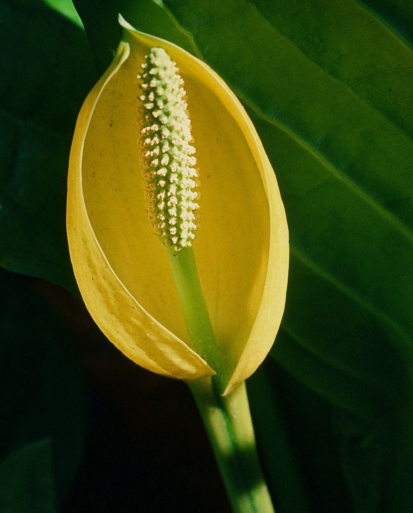
No other yellow is as bold and bright. It may be that their habitat plays a role, for it is typically dank and dark. Few other lanterns glow that brightly. There is something otherworldly as they rise like luminous, golden flames from the dark swamp mud.
They have had a lot of practice at this as they are members of one of the oldest flowering plant families – Araceae – and appeared about 245 million years ago. That means they beat the dinosaurs by about 15 million years. They’re clearly doing something right.
Bees hadn’t even appeared yet and were millions of years away. There was no need for frilly petals of very complex flowers to entice the kinds of pollinators that evolved millions of years later. Swamp lantern flowers are tiny, yellow-green, simple. Many are packed onto a spike called a spadix, which is surrounded by what was once a leaf, evolved into a brilliant yellow bract. Flies, midges and beetles are the main pollinators.
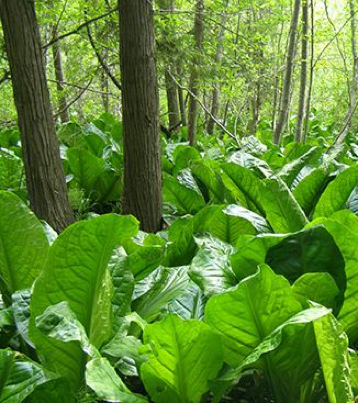
The leaves are something else and appear to be the largest leaves of any native Canadian plant. It takes only weeks before the bright yellow flower parts are overshadowed by enormous, brilliant green leaves. As a youth, I spent what time I could learning about nature by living off the land. I never tried eating a plant without having read something about it and watching whether other animals ate it. You can eat young swamp lantern stalks if you boil them; I never tried the roots but some First Nations groups did.
Out of frustration I did discover another potential use. The mosquitoes were maddening, so I cut 3 large leaves, tied them together and draped them over my head. That impeded vision but seemed to deter the mosquitoes. I now know mosquito nets work better, but I’m sure the leaves would make a fine rain hat.
Despite the fact that other animals feed on swamp lanterns or skunk cabbage, there is an important reason for you to avoid trying it. The ‘Ar’ of the family name for swamp lanterns (Araceae) apparently comes from the Arabic ‘nar’ for fire or heat. Both the leaves and roots of swamp lanterns contain needle-like crystals of calcium oxalate. These can puncture the mucous membranes of your mouth and throat in a most fiery and unpleasant manner. Ever inquisitive, I naturally tried just a wee bit of leaf. It’s like having ground glass in your mouth that you can’t spit out and that won’t go away. Early First Nations people knew that cooking skunk cabbage leaves and roots in many changes of water neutralized the effect, to provide a reliable but not at all choice source of calories when food was scarce.
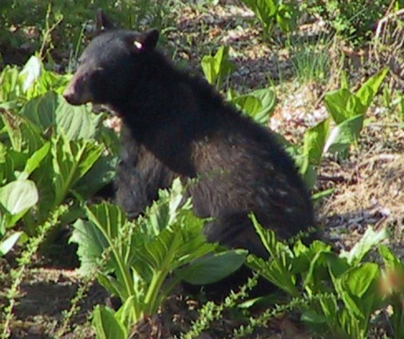
I inadvertently demonstrated that it takes quite some time to be shed of a larger mouthful. I was leading three grad students as we backpacked into a grizzly bear study area. Ever the teacher, I waxed eloquent about the fact that black and grizzly bears seem unbothered by those sharp crystals and seek out the leaves of skunk cabbage in spring.
I was going on about how surprising I found this and was about to tell them never to try it when I heard loud sputtering and cursing behind me. The most inquisitive student had tried it. It took some time before he was able to enjoy eating. Some say the plant acts as a cathartic that gets bear’s sluggish digestive systems into high gear after winter’s inactivity. Maybe.
Despite the fact that we handle calcium oxalate crystals poorly, First Nations did find a variety of uses for swamp lanterns. BC ethnobotanist Nancy Turner notes that the waxy leaves of skunk cabbage were used to wrap, carry, dry and store many foods. When vegetables, meat and fish were steamed, it was common to encase each food separately in skunk cabbage leaves. Not only were the juices of each food isolated, but the wrapping imparted no additional flavour. Skunk cabbage leaves were folded into cones to make disposable, biodegradable drinking cups (not hats). In times of famine, when the Haida had no bait for their yew-wood fish hooks, they used its roots as lures. The tuber looks like a bunch of fleshy white fingers and can trick a halibut into thinking it’s gulping down an octopus.
Next time you see a swamp lantern, look inside the yellow bract. You will probably see wee beetles and other insects crawling over the tiny flowers on the spike or spadix. The species grappled with transgender issues well before we appeared. Female flowers are produced first before switching over to male flowers, with a brief period of bisexuality – though they seldom self-pollinate. Flies, midges and beetles are attracted by the smell and facilitate pollination.
Those that consider skunk cabbage to smell like a skunk haven’t smelled a skunk. But it isn’t an attractive smell to us and seems more apt to attract carrion flies. Some believe that the west coast species, Lysichiton americanus, releases different odours at different temperatures to attract a variety of insects.
A final thought. The stately white skunk cabbage (Lysichiton camtschatcensis) attracts large spring pilgrimages to bogs in the Hokkaido region. Its Japanese name, Mizu Basho, apparently translates as ‘water’ plus ‘banana-like plant’ and is considered sacred by Buddhists. It has further significance because Basho is also the name of a revered 15th century Japanese poet. I make my pilgrimage at least annually. Not to Hokkaido, but to one of the nearby damp, wooded reas. The luminous, yellow-gold flames of swamp lanterns merit some sort of homage.