From Creek to Classroom: The Watershed Project
Learning to care for local watersheds, one dip net at a time
By Mary-Ruth Low, Communications Manager
January 24, 2026
A Watershed Moment
A “watershed moment” is often used to describe a turning point, a moment when something shifts and a new way forward becomes clear. At A Rocha, we seek to have everyone have a watershed moment of their own. Not just as a metaphor, but quite literally, through learning to notice, understand, and care for the watersheds they are a part of.
A watershed is “a land area that channels rainfall and snowmelt to creeks, streams, and rivers, and eventually to outflow points such as reservoirs, bays, and the ocean” (NOAA), and everyone who relies on fresh, clean water, (i.e., all of us!) is invariably connected to a watershed. In fact, 90% of Canada’s drinking water comes from surface water. In the Fraser River Basin alone there are 12 major watersheds spanning 220,000 km2 (that’s 32 million football fields), sustaining communities and species alike, such as salmon, which rely on clean, flowing rivers to reach spawning grounds.
How the Watershed Project Began

Ruth & Jess from the BC team training teachers from Elgin Park Secondary School on assessing watershed health.
The Watershed Project grew out of an encouraging partnership with the East Kensington Outdoor Learning (EKOLogy) program in 2022, when our BC Environmental Education team began to dream about how students might move beyond coming to the A Rocha BC Centre for a class field trip, and instead, move to understand and care for their own local watershed.
With generous support from TD Friends of the Environment Foundation, the vision has firmly taken shape and today more than 550 students from five schools across Surrey, BC have participated in the Watershed Project. Each of the partnering schools are located near rivers and creeks, allowing students the opportunity to learn firsthand about the health of their local watersheds.

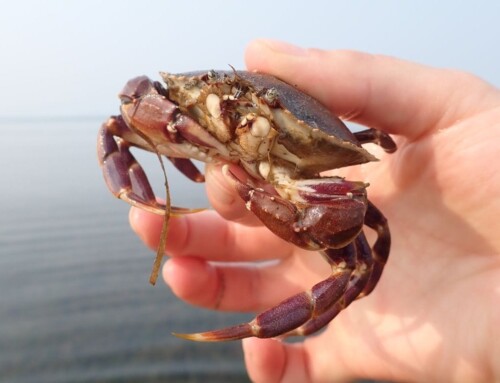
An in-situ survey training involves collecting and identifying stream invertebrates. The presence of certain species act as bioindicators, providing information on the health of the stream.
Learning by Paying Attention
Now in its fourth year, the Watershed Project begins with an initial assessment of their local creek or river, particularly to find suitable access points for students to conduct their surveys safely. Teachers then take part in training sessions with the A Rocha team, including an on site training where teachers get to use resources and tools found in our Watershed Kit to carry out the surveys.
Following that, teachers and students head outside, clipboards and dip nets in hand, to learn about and assess their watershed health. Students measure water quality (including temperature, dissolved oxygen, pH, nutrients, and turbidity), observe stream flow, identify aquatic invertebrates, record plant species, note salmonid presence, and assess the condition of the riparian forest.
Students jot down their observations and log their results, sharing them with A Rocha, and the water quality test results with the City of Surrey. Students are also encouraged to journal about their experience and where appropriate, display a sign about the project close to the river.
“It was nice to see specimens in the wild and nature. It feels more real than just seeing them on microscope slides,” Biology 11 student, Elgin Park Secondary School.
“The students were deeply engaged and excited to learn outside of the classroom. They gained skills applicable to biology-based research and environmental studies that are not possible through in class investigations.” Gretta Heintz, Biology Teacher, Elgin Park Secondary School
Beyond the data collection, the Watershed Project invites students to pay attention and notice how their watershed is doing, how human activities may affect it, and how care can be practiced locally. In the process of understanding their watershed, students learn to love their place, and grow in responsibility and action, one dip net at a time.
“I have been working very closely with Chief Chappell from the Semiahmoo First Nation. It was his recommendation that I connect with ARocha to understand their commitment to the Ta’talu watershed and their education programs. I have resided in this area for nearly 30 years and new very little about the Ta’talu until very recently thanks to A Rocha.” Kristy Crnkovich, Principal, Xw’epiteng Elementary School (the first land-based program in the Surrey School District)
Interested to get your students to learn and care for their local watershed? Does your school have a stream or creek close to the property? For partnership inquiries email education.bc@arocha.ca
Keen to have your own watershed moment? Create your own by answering these questions.
A huge thank you to our wonderful school partners caring for their watershed:
East Kensington Elementary School – Erickson Creek
Semiahmoo Trail Elementary School – Anderson Creek
Xw’epiteng Elementary School – Little Campbell River
Douglas Elementary School – Little Campbell River
Elgin Park Secondary School – Chantrell Creek